
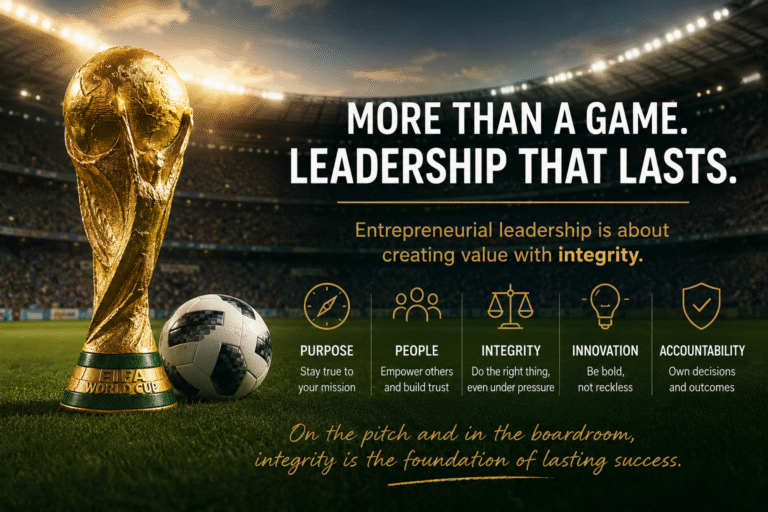
As the men’s World Cup reaches its decisive stages, attention naturally turns to the players and managers. Every substitution is analysed, every tactical decision debated and every moment replayed from countless angles.
But some of the most important leadership lessons are found away from the pitch.
Behind the tournament sits one of the world’s largest and most influential sporting organisations. FIFA’s leadership is responsible not simply for delivering a competition, but for stewarding a global game, balancing the interests of nations, players, supporters, sponsors and governments, while maintaining confidence in the integrity of football itself.
Leading at that level is never straightforward.
Every decision is subject to scrutiny. Every action is interpreted through different perspectives. Success is measured not only by what is achieved, but by whether people believe decisions have been fair, transparent and consistent.
That is the real challenge of leadership.
Integrity is often described as doing the right thing. In reality, it is about something deeper. It is about creating confidence that decisions are guided by principles rather than convenience. It is about earning trust, particularly when there is no perfect answer.
The higher leaders rise, the more this matters.
In complex organisations, leadership is rarely about making everyone happy. It is about navigating competing priorities while remaining true to the organisation’s purpose. It requires the confidence to make difficult decisions and the humility to explain them, listen to challenge and be accountable for the outcomes.
Universities face many of the same leadership challenges.
Their leaders are balancing financial sustainability, student expectations, research ambitions, international partnerships, technological change and increasing public scrutiny. They are expected to innovate, respond quickly to external change and create opportunities for their institutions to thrive.
This is why entrepreneurial leadership has never been more important.
But entrepreneurial leadership is not simply about being innovative or taking risks. It is about creating lasting value in ways that strengthen trust rather than diminish it. The most entrepreneurial leaders recognise that reputation is built through consistency, transparency and the confidence others have in their judgement.
That confidence is earned long before a difficult decision arrives.
It is created through strong governance, openness to challenge, clarity of purpose and a willingness to explain not only what has been decided, but why. It is built by creating cultures where people feel able to question, contribute and hold one another to account.
When those foundations exist, organisations are better able to navigate uncertainty because people trust both the process and the leadership behind it.
This is why integrity sits at the heart of entrepreneurial leadership.
At NCEE, our Entrepreneurial University Leaders programme encourages leaders to think beyond strategy and performance. It challenges them to consider how they build trust, shape culture and lead through complexity. Entrepreneurial leadership is not about finding easy answers; it is about making thoughtful decisions in uncertain environments while remaining true to an institution’s purpose and values.
The World Cup reminds us that leadership is always visible. Whether on the touchline, in the boardroom or across an entire organisation, every decision contributes to the culture people experience and the trust they place in those who lead.
Ultimately, integrity is not measured when everything is going well.
It is measured when the pressure is greatest, expectations are highest and the world is watching.