Stay connected:
General enquiries: enquiries@ncee.org.uk    |   Leadership programme: leaders@ncee.org.uk

EDGE Series — Entrepreneurship • Digital • Growth • Education

Online and Free to Join

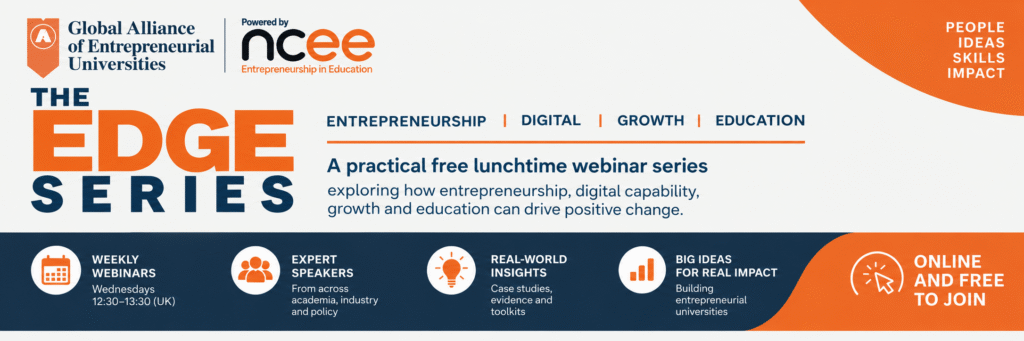
EDGE Series is a fast, practical, lunchtime webinar series exploring how entrepreneurship, digital capability, growth and education can support prosperity.

When: Wednesdays, 12:30–13:30 (UK), 4 Feb – 25 Mar 2026
Format: 5 minute introduction, 30-minute talk • 15-minute Q&A • 5-minute takeaway
Who it’s for: University leaders & staff, founders, investors, civic partners, skills providers, policy shapers, and anyone building entrepreneurial universities.

What you’ll get

  • Real case studies and toolkits you can use tomorrow
  • Fresh evidence from research and evaluation
  • Lived-experience voices and practical lessons

Series themes

  • Entrepreneurial Universities & Partnerships
  • Digital Transformation & AI for Good
  • Scaling Impact: From Pilot to System
  • Skills, Inclusion & Regional Growth
  • Public–Private Collaboration & Finance
  • Policy that Works (and what to avoid)

Register once, attend many: One sign-up gives access to the full series.

Call to action:
➡️ Sign up for the EDGE Series (free)
➡️ Propose a talk (speakers welcome from academia, industry, public and third sectors) – contact karen.biscombe@ncee.org.uk


Confirmed Sessions

4th February: Dr Rajab Ghandour, Senior Lecturer Business Intelligence and Data Analysis | Senior Fellow HEA, Liverpool Business School

AI and digital transformation of universities

This session offers a focused exploration of how AI is driving digital transformation within entrepreneurial universities and their wider regional ecosystems. It highlights how universities can extend this digital capacity to support SMEs through knowledge exchange and skills development.

11th February: Zaineb Djebali, Senior Lecturer (Entrepreneurship) University of Liverpool

Beyond Business: Embedding Entrepreneurship Education Across Disciplines

Embedding entrepreneurship education (EE) across disciplines remains an ongoing challenge, particularly for entrepreneurship educators who continue to grapple with how to design, position, and sustain multidisciplinary EE within complex institutional contexts. This  interactive lunchtime webinar introduces a Stakeholder Engagement Methodology (SEM), drawing on Stakeholder Management Theory (SMT) and the Interest–Influence Matrix to illustrate how a cross-disciplinary approach to EE has been successfully embedded at the University of Liverpool (UK).

4th March: Sasha Kenney, Entrepreneurship Coordinator (Enterprise and Engagement), Wrexham University

Entrepreneurial Mindset: What It Is, Why It Matters, and How to Cultivate It

This session will explore the concept of entrepreneurial mindset – what it really means, why it is valuable beyond starting a business, and how it can be learned. Sasha will draw on her experience as an entrepreneurship coordinator at Wrexham University, her own entrepreneurial journey, and her PhD research into Entrepreneurial Mindset.

11th March: Ben Mumby-Croft, Director of Entrepreneurship at Imperial College London and Site Lead for Creative Destruction Lab (CDL)

Building an Outstanding Entrepreneurial University – The Imperial Experience

This session uses Imperial College London as a live case study of how a science and technology-led university can systematically turn curiosity into impact. The session explores the design choices behind the Imperial model and what other universities can practically borrow, adapt, or avoid when building entrepreneurship at scale.

18th March: Catherine Foottit, Student Enterprise and Entrepreneurship Manager; and Jo Living, Entrepreneurship Development Manager, Anglia Ruskin University (ARU)

Scaling Impact

ARU will set out how it has re-imagined its approach to enterprise education over the last 3 years to transform graduate entrepreneurship. The session will focus on ARU’s Freelancer Fast-Start Programme as a case study, sharing good practice on delivering impactful and inclusive start-up support to a diverse student body.


Scroll to Top